Car Reader Plug on 2007 Ford Bad Environmental Read

Various angles and details of a "MaxScan OE509" - a fairly typical onboard diagnostics (OBD) handheld scanner from the first decade of the 21st century. Used to connect to the SAE J1962 Information Link Connector (DLC) constitute in many cars of the era.
On-board diagnostics (OBD) is an automotive term referring to a vehicle'due south self-diagnostic and reporting adequacy. OBD systems requite the vehicle owner or repair technician access to the status of the diverse vehicle sub-systems. The amount of diagnostic data bachelor via OBD has varied widely since its introduction in the early 1980s versions of on-lath vehicle computers. Early versions of OBD would simply illuminate a malfunction indicator light or "idiot light" if a trouble was detected but would not provide any data equally to the nature of the problem. Modern OBD implementations use a standardized digital communications port to provide real-time data in addition to a standardized series of diagnostic trouble codes, or DTCs, which permit a person to rapidly identify and remedy malfunctions within the vehicle.
History [edit]
- 1968: Volkswagen introduces the first on-board computer system, in their fuel-injected Type three models. This arrangement is entirely analog with no diagnostic capabilities.
- 1975: Bosch and Bendix EFI systems are adopted by major automotive manufacturers in an effort to improve tail piping emissions. These systems are also analog in nature, though some provide rudimentary diagnostic capability through mill tools, such as the Kent Moore J-25400, compatible with the Datsun 280Z, and the Cadillac Seville.
- 1980: General Motors introduces the showtime digital OBD organization on their 1980 Eldorado and Seville models. A proprietary 5-pin ALDL interfaces with the Engine Control Module (ECM) to initiate a diagnostic asking and provide a serial data stream. The protocol communicates at 160 baud with Pulse-width modulation (PWM) signaling and monitors all engine management functions. Existent-fourth dimension sensor data, component overrides, and Diagnostic Trouble Codes (DTC'southward) are also displayed through the electronic climate control system'due south digital readout when in diagnostic mode.[i]
- 1982: RCA defines an analog STE/Ice vehicle diagnostic standard used in the CUCV, M60 tank and other armed services vehicles of the era for the U.s. Army.[2]
- 1986: An upgraded version of the ALDL protocol appears which communicates at 8192 baud with half-duplex UART signaling. This protocol is divers in GM XDE-5024B.
- 1988: The California Air Resource Board (CARB) requires that all new vehicles sold in California in 1988 and newer vehicles have some basic OBD adequacy.[3] These requirements are generally referred to equally "OBD-I", though this name is not applied until the introduction of OBD-II. The information link connector and its position are not standardized, nor is the data protocol. The Society of Automotive Engineers (SAE) recommends a standardized diagnostic connector and set of diagnostic examination signals.
- ~1994: Motivated past a desire for a state-wide emissions testing program, the CARB issues the OBD-2 specification and mandates that it be adopted for all cars sold in California starting in model year 1996 (see CCR Championship 13 Section 1968.ane and 40 CFR Part 86 Section 86.094). The DTCs and connector suggested by the SAE are incorporated into this specification.
- 1996: The OBD-2 specification is made mandatory for all cars sold in the United States.
- 2001: The European Spousal relationship makes EOBD mandatory for all gasoline (petrol) vehicles sold in the European Union, starting in MY2001 (see European emission standards Directive 98/69/EC[4]).
- 2004: The European Union makes EOBD mandatory for all diesel vehicles sold in the European Spousal relationship
- 2006: All vehicles manufactured in Australia and New Zealand are required to be OBD-Ii compliant later January ane, 2006.[five]
- 2008: All cars sold in the Usa are required to use the ISO 15765-4[6] signaling standard (a variant of the Controller Area Network (CAN) passenger vehicle).[7]
- 2008: Certain lite vehicles in China are required past the Environmental Protection Administration Part to implement OBD (standard GB18352[eight]) by July 1, 2008.[ citation needed ] Some regional exemptions may apply.
- 2010: HDOBD (heavy duty) specification is made mandatory for selected commercial (not-passenger car) engines sold in the United States.
Standard interfaces [edit]
ALDL [edit]
GM's ALDL (Assembly Line Diagnostic Link) is sometimes referred as a predecessor to, or a manufacturer's proprietary version of, an OBD-I diagnostic. This interface was made in unlike varieties and changed with power train command modules (aka PCM, ECM, ECU). Different versions had slight differences in pin-outs and baud rates. Earlier versions used a 160 baud rate, while later versions went up to 8192 baud and used bi-directional communications to the PCM.[9] [10]
OBD-I [edit]
The regulatory intent of OBD-I was to encourage motorcar manufacturers to blueprint reliable emission control systems that remain effective for the vehicle's "useful life".[ citation needed ] The hope was that by forcing annual emissions testing for California,[ citation needed ] and denying registration to vehicles that did non pass, drivers would tend to purchase vehicles that would more reliably laissez passer the examination. OBD-I was largely unsuccessful,[ citation needed ] equally the means of reporting emissions-specific diagnostic information was not standardized. Technical difficulties with obtaining standardized and reliable emissions information from all vehicles led to an disability to implement the almanac testing program effectively.[ citation needed ]
The Diagnostic Trouble Codes (DTC's) of OBD-I vehicles can usually be constitute without an expensive scan tool. Each manufacturer used their own Diagnostic Link Connector (DLC), DLC location, DTC definitions, and procedure to read the DTC's from the vehicle. DTC's from OBD-I cars are ofttimes read through the blinking patterns of the 'Check Engine Light' (CEL) or 'Service Engine Soon' (SES) calorie-free. By connecting certain pins of the diagnostic connector, the 'Check Engine' light volition blink out a two-digit number that corresponds to a specific mistake condition. The DTC'due south of some OBD-I cars are interpreted in different ways, nonetheless. Cadillac (gasoline) fuel-injected vehicles are equipped with bodily on-board diagnostics, providing problem codes, actuator tests and sensor data through the new digital Electronic Climate Control display.
Belongings down 'Off' and 'Warmer' for several seconds activates the diagnostic mode without the need for an external scan tool. Some Honda engine computers are equipped with LEDs that light upwardly in a specific pattern to indicate the DTC. General Motors, some 1989-1995 Ford vehicles (DCL), and some 1989-1995 Toyota/Lexus vehicles accept a live sensor data stream available; even so, many other OBD-I equipped vehicles do not. OBD-I vehicles have fewer DTC'due south bachelor than for OBD-2 equipped vehicles.
OBD-i.five [edit]
OBD one.five refers to a partial implementation of OBD-2 which General Motors used on some vehicles in 1994, 1995, & 1996. (GM did not apply the term OBD one.5 in the documentation for these vehicles — they simply have an OBD and an OBD-Ii section in the service manual.)
For example, the 94–95 Corvettes have ane post-catalyst oxygen sensor (although they accept two catalytic converters), and have a subset of the OBD-II codes implemented. For a 1994 Corvette the implemented OBD-II codes are P0116-P0118, P0131-P0135, P0151-P0155, P0158, P0160-P0161, P0171-P0175, P0420, P1114-P1115, P1133, P1153 and P1158.[11]
This hybrid system was present on the GM H-trunk cars in 94–95, Westward-body cars (Buick Regal, Chevrolet Lumina ('95 only), Chevrolet Monte Carlo ('95 only), Pontiac Thousand Prix, Oldsmobile Cutlass Supreme) in 94–95, Fifty-body (Chevrolet Beretta/Corsica) in 94–95, Y-trunk (Chevrolet Corvette) in 94–95, on the F-body (Chevrolet Camaro and Pontiac Firebird) in 95 and on the J-Torso (Chevrolet Cavalier and Pontiac Sunfire) and Northward-Trunk (Buick Skylark, Oldsmobile Achieva, Pontiac One thousand Am) in 95 and 96 and likewise on '94-'95 Saab vehicles with the naturally aspirated ii.3.
The pinout for the ALDL connectedness on these cars is equally follows:
| ane | 2 | 3 | 4 | v | half dozen | 7 | 8 |
| ix | 10 | 11 | 12 | 13 | 14 | 15 | 16 |
For ALDL connections, pin 9 is the data stream, pins iv and five are ground, and pin 16 is battery voltage.
An OBD 1.5 compatible scan tool is required to read codes generated by OBD 1.v.
Additional vehicle-specific diagnostic and command circuits are also available on this connector. For case, on the Corvette there are interfaces for the Form 2 series data stream from the PCM, the CCM diagnostic last, the radio data stream, the airbag system, the selective ride command system, the low tire force per unit area warning system, and the passive keyless entry organisation.[12]
An OBD 1.five has as well been used in the Ford Scorpio since 95.[thirteen]
OBD-2 [edit]
OBD-Ii is an comeback over OBD-I in both capability and standardization. The OBD-Ii standard specifies the blazon of diagnostic connector and its pinout, the electrical signalling protocols available, and the messaging format. It also provides a candidate list of vehicle parameters to monitor forth with how to encode the data for each. There is a pin in the connector that provides power for the scan tool from the vehicle battery, which eliminates the need to connect a browse tool to a power source separately. Notwithstanding, some technicians might notwithstanding connect the scan tool to an auxiliary power source to protect data in the unusual issue that a vehicle experiences a loss of electrical power due to a malfunction. Finally, the OBD-II standard provides an extensible listing of DTCs.[14] As a result of this standardization, a single device can query the on-board reckoner(southward) in any vehicle. This OBD-2 came in two models OBD-IIA and OBD-IIB. OBD-II standardization was prompted by emissions requirements, and though only emission-related codes and data are required to be transmitted through it, most manufacturers have made the OBD-II Data Link Connector the only i in the vehicle through which all systems are diagnosed and programmed. OBD-II Diagnostic Trouble Codes are 4-digit, preceded by a letter: P for powertrain (engine and transmission), B for body, C for chassis, and U for network.
OBD-Ii diagnostic connector [edit]
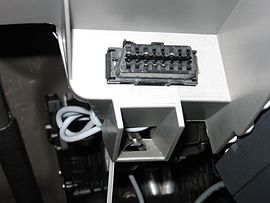
Female OBD-Ii connector on a auto

Female OBD-II connector pinout - front view
The OBD-Ii specification provides for a standardized hardware interface—the female 16-pin (2x8) J1962 connector. Unlike the OBD-I connector, which was sometimes found under the hood of the vehicle, the OBD-Ii connector is required to exist within 2 feet (0.61 1000) of the steering wheel (unless an exemption is applied for by the manufacturer, in which case information technology is nonetheless somewhere within attain of the driver).
SAE J1962 defines the pinout of the connector every bit:
| one | Manufacturer discretion. GM: J2411 GMLAN/SWC/Single-Wire Can. VW/Audi: Switched +12 to tell a scan tool whether the ignition is on. | 9 | Manufacturer discretion. GM: 8192 baud ALDL where fitted. BMW and Toyota: RPM signal. |
|---|---|---|---|
| 2 | Autobus positive Line of SAE J1850 PWM and VPW | 10 | Bus negative Line of SAE J1850 PWM only (not SAE 1850 VPW) |
| 3 | Manufacturer discretion. Ford DCL(+) Argentina, Brazil (pre OBD-II) 1997–2000, USA, Europe, etc. Chrysler CCD Bus(+) Ethernet TX+ (Diagnostics over IP) | 11 | Manufacturer discretion. Ford DCL(-) Argentina, Brazil (pre OBD-II) 1997–2000, USA, Europe, etc. Chrysler CCD Jitney(-) Ethernet TX- (Diagnostics over IP) |
| 4 | Chassis ground | 12 | Not connected Manufacturer discretion: Ethernet RX+ (Diagnostics over IP) |
| v | Point ground | 13 | Manufacturer discretion. Ford: FEPS - Programming PCM voltage Ethernet RX- (Diagnostics over IP) |
| 6 | Tin can high (ISO 15765-4 and SAE J2284) | 14 | CAN low (ISO 15765-iv and SAE J2284) |
| 7 | K-line of ISO 9141-ii and ISO 14230-4 | 15 | L-line of ISO 9141-2 and ISO 14230-4 |
| 8 | Manufacturer discretion. Many BMWs: A second K-line for non OBD-2 (Trunk/Chassis/Infotainment) systems. Actuate Ethernet (Diagnostics over IP) | 16 | Bombardment voltage |
The assignment of unspecified pins is left to the vehicle manufacturer's discretion.
EOBD [edit]
The European on-board diagnostics (EOBD) regulations are the European equivalent of OBD-Two, and employ to all passenger cars of category M1 (with no more than than eight passenger seats and a Gross Vehicle Weight rating of 2500 kg or less) starting time registered within Eu member states since January 1, 2001 for petrol (gasoline) engined cars and since January 1, 2004 for diesel fuel engined cars.[15]
For newly introduced models, the regulation dates practical a year before - January 1, 2000 for petrol and Jan 1, 2003 for diesel.
For passenger cars with a Gross Vehicle Weight rating of greater than 2500 kg and for calorie-free commercial vehicles, the regulation dates applied from January 1, 2002 for petrol models, and January 1, 2007 for diesel models.
The technical implementation of EOBD is essentially the same as OBD-Ii, with the same SAE J1962 diagnostic link connector and betoken protocols being used.
With Euro V and Euro Six emission standards, EOBD emission thresholds are lower than previous Euro III and Four.
EOBD fault codes [edit]
Each of the EOBD fault codes consists of v characters: a letter, followed by four numbers. The letter refers to the system beingness interrogated e.thousand. Pxxxx would refer to the powertrain system. The next character would exist a 0 if complies to the EOBD standard. So it should wait similar P0xxx.
The next grapheme would refer to the sub system.
- P00xx - Fuel and Air Metering and Auxiliary Emission Controls.
- P01xx - Fuel and Air Metering.
- P02xx - Fuel and Air Metering (Injector Circuit).
- P03xx - Ignition Arrangement or Misfire.
- P04xx - Auxiliary Emissions Controls.
- P05xx - Vehicle Speed Controls and Idle Control System.
- P06xx - Estimator Output Circuit.
- P07xx - Manual.
- P08xx - Transmission.
The post-obit two characters would refer to the private error within each subsystem.[xvi]
EOBD2 [edit]
The term "EOBD2" is marketing speak used by some vehicle manufacturers to refer to manufacturer-specific features that are non actually part of the OBD or EOBD standard. In this case "E" stands for Enhanced.
JOBD [edit]
JOBD is a version of OBD-II for vehicles sold in Japan.
ADR 79/01 & 79/02 (Australian OBD standard) [edit]
The ADR 79/01 (Vehicle Standard (Australian Design Rule 79/01 – Emission Control for Lite Vehicles) 2005) standard is the Australian equivalent of OBD-Two.
Information technology applies to all vehicles of category M1 and N1 with a Gross Vehicle Weight rating of 3500 kg or less, registered from new within Australia and produced since January 1, 2006 for petrol (gasoline) engined cars and since January ane, 2007 for diesel fuel engined cars.[17]
For newly introduced models, the regulation dates applied a yr before - January 1, 2005 for petrol and January 1, 2006 for diesel fuel.
The ADR 79/01 standard was supplemented by the ADR 79/02 standard which imposed tighter emissions restrictions, applicative to all vehicles of class M1 and N1 with a Gross Vehicle Weight rating of 3500 kg or less, from July ane, 2008 for new models, July 1, 2010 for all models.[18]
The technical implementation of this standard is essentially the same equally OBD-II, with the same SAE J1962 diagnostic link connector and indicate protocols being used.
OBD-2 signal protocols [edit]
At that place are v signaling protocols that are permitted with the OBD-Ii interface. Almost vehicles implement merely one of the protocols. It is ofttimes possible to deduce the protocol used based on which pins are present on the J1962 connector:[xix]
- SAE J1850 PWM (pulse-width modulation — 41.6 kB/sec, standard of the Ford Motor Company)
- pin 2: Passenger vehicle+
- pin 10: Double-decker–
- High voltage is +5 Five
- Bulletin length is restricted to 12 bytes, including CRC
- Employs a multi-principal arbitration scheme called 'Carrier Sense Multiple Admission with Non-Destructive Arbitration' (CSMA/NDA)
- SAE J1850 VPW (variable pulse width — 10.4/41.6 kB/sec, standard of General Motors)
- pin 2: Bus+
- Bus idles low
- Loftier voltage is +7 V
- Conclusion point is +three.5 V
- Message length is restricted to 12 bytes, including CRC
- Employs CSMA/NDA
- ISO 9141-2.[twenty] This protocol has an asynchronous series data rate of 10.iv kbps.[21] Information technology is somewhat similar to RS-232; however, the signal levels are dissimilar, and communications happen on a single, bidirectional line without additional handshake signals. ISO 9141-2 is primarily used in Chrysler, European, and Asian vehicles.
- pin 7: M-line
- pin 15: L-line (optional)
- UART signaling
- K-line idles high, with a 510 ohm resistor to Fivebatt
- The active/dominant state is driven depression with an open-collector commuter.
- Bulletin length is Max 260Bytes. Information field MAX 255.
- ISO 14230 KWP2000 (Keyword Protocol 2000)
- pin 7: K-line
- pin 15: Fifty-line (optional)
- Physical layer identical to ISO 9141-2
- Data rate 1.2 to 10.4 kBaud
- Bulletin may contain upwardly to 255 bytes in the data field
- ISO 15765 Can (250 kbit/s or 500 kbit/due south). The CAN protocol was developed past Bosch for automotive and industrial command. Unlike other OBD protocols, variants are widely used outside of the automotive industry. While it did non run across the OBD-II requirements for U.Southward. vehicles prior to 2003, equally of 2008 all vehicles sold in the US are required to implement CAN as one of their signaling protocols.
- pin 6: Tin High
- pivot 14: Tin Low
All OBD-II pinouts utilize the same connector, but different pins are used with the exception of pin 4 (battery ground) and pin 16 (battery positive).
OBD-Two diagnostic data available [edit]
OBD-II provides access to data from the engine control unit (ECU) and offers a valuable source of information when troubleshooting bug inside a vehicle. The SAE J1979 standard defines a method for requesting various diagnostic information and a list of standard parameters that might exist available from the ECU. The various parameters that are available are addressed past "parameter identification numbers" or PIDs which are defined in J1979. For a list of basic PIDs, their definitions, and the formula to catechumen raw OBD-II output to meaningful diagnostic units, run into OBD-2 PIDs. Manufacturers are not required to implement all PIDs listed in J1979 and they are allowed to include proprietary PIDs that are not listed. The PID request and information retrieval organization gives admission to real fourth dimension performance information too as flagged DTCs. For a list of generic OBD-II DTCs suggested past the SAE, see Table of OBD-2 Codes. Individual manufacturers often heighten the OBD-Ii code set with additional proprietary DTCs.
Mode of performance/OBD services [edit]
Here is a basic introduction to the OBD advice protocol co-ordinate to ISO 15031. In SAE J1979 these "modes" were renamed to "services", starting in 2003.
- Service / Mode
$01is used to place what powertrain information is available to the scan tool. - Service / Mode
$02displays Freeze Frame data.[22] - Service / Mode
$03lists the emission-related "confirmed" diagnostic problem codes stored. It displays verbal numeric, 4 digit codes identifying the faults. - Service / Mode
$04is used to clear emission-related diagnostic information. This includes clearing the stored pending/confirmed DTCs and Freeze Frame data.[23] - Service / Style
$05displays the oxygen sensor monitor screen and the test results gathered about the oxygen sensor. In that location are ten numbers available for diagnostics:-
$01Rich-to-Lean O2 sensor threshold voltage -
$02Lean-to-Rich O2 sensor threshold voltage -
$03Low sensor voltage threshold for switch time measurement -
$04High sensor voltage threshold for switch time measurement -
$05Rich-to-Lean switch time in ms -
$06Lean-to Rich switch fourth dimension in ms -
$07Minimum voltage for test -
$08Maximum voltage for examination -
$09Time between voltage transitions in ms
-
- Service / Fashion
$06is a Request for On-Lath Monitoring Examination Results for Continuously and Non-Continuously Monitored System. There are typically a minimum value, a maximum value, and a electric current value for each non-continuous monitor. - Service / Fashion
$07is a Asking for emission-related diagnostic trouble codes detected during current or last completed driving cycle. It enables the external test equipment to obtain "pending" diagnostic trouble codes detected during electric current or last completed driving cycle for emission-related components/systems. This is used by service technicians afterward a vehicle repair, and after clearing diagnostic information to see test results afterward a single driving wheel to decide if the repair has fixed the problem. - Service / Manner
$08could enable the off-board exam device to control the performance of an on-board system, test, or component. - Service / Fashion
$09is used to retrieve vehicle data. Amid others, the following data is available:- VIN (Vehicle Identification Number): Vehicle ID
- CALID (Calibration Identification): ID for the software installed on the ECU
- CVN (Calibration Verification Number): Number used to verify the integrity of the vehicle software. The manufacturer is responsible for determining the method of calculating CVN(s), e.grand. using checksum.
- In-use performance counters
- Gasoline engine : Catalyst, Master oxygen sensor, Evaporating system, EGR system, VVT system, Secondary air system, and Secondary oxygen sensor
- Diesel engine : NMHC goad, NOx reduction catalyst, NOx absorber Particulate affair filter, Exhaust gas sensor, EGR system, VVT system, Boost pressure level command, Fuel system.
- Service / Mode
$0Alists emission-related "permanent" diagnostic problem codes stored. As per CARB, whatsoever diagnostic problem codes that is commanding MIL on and stored into non-volatile memory shall be logged as a permanent fault lawmaking.
See OBD-Two PIDs for an extensive listing of this information.
Applications [edit]
Various tools are available that plug into the OBD connector to access OBD functions. These range from unproblematic generic consumer level tools to highly sophisticated OEM dealership tools to vehicle telematic devices.
Paw-held scan tools [edit]

Multi-brand vehicle diagnostics organisation handheld Autoboss V-xxx with adapters for connectors of several vehicle manufacturers.[24]
A range of rugged mitt-held scan tools is available.
- Simple mistake code readers/reset tools are mostly aimed at the consumer level.
- Professional paw-held scan tools may possess more advanced functions
- Access more advanced diagnostics
- Set manufacturer- or vehicle-specific ECU parameters
- Access and control other control units, such every bit air bag or ABS
- Existent-fourth dimension monitoring or graphing of engine parameters to facilitate diagnosis or tuning
Mobile device-based tools and assay [edit]
Mobile device applications allow mobile devices such as cell phones and tablets to display and manipulate the OBD-II data accessed via USB adaptor cables or Bluetooth adapters plugged into the car'southward OBD Ii connector. Newer devices on the market are equipped with GPS sensors and the ability to transmit vehicle location and diagnostics information over a cellular network. Modern OBD-II devices can therefore present be used to for example locate vehicles, monitor driving behavior in addition to reading Diagnostics Trouble Codes (DTC). Fifty-fifty more advanced devices let users to reset engine DTC codes, finer turning off engine lights in the dashboard, however resetting the codes does non address the underlying issues and can in worst case scenarios even lead to engine breakage where the source issue is serious and left unattended for long periods of time.[25] [26]
OBD2 Software [edit]
An OBD2 software package when installed in a computer (Windows, Mac, or Linux) tin help diagnose the onboard arrangement, read and erase DTCs, turn off MIL, show real-time data, and measure vehicle fuel economic system.[27]
To use OBD2 software, one needs to have a Bluetooth or WIFI OBD2 adapter[28] plugged in the OBD2 port to enable the vehicle to connect with the computer where the software is installed.[29]
PC-based scan tools and analysis platforms [edit]

Typical uncomplicated USB KKL Diagnostic Interface without protocol logic for signal level adjustment.
A PC-based OBD analysis tool that converts the OBD-Two signals to series information (USB or serial port) standard to PCs or Macs. The software then decodes the received data to a visual display. Many popular interfaces are based on the ELM327 or STN[30] OBD Interpreter ICs, both of which read all 5 generic OBD-2 protocols. Some adapters now use the J2534 API assuasive them to access OBD-Ii Protocols for both cars and trucks.
In addition to the functions of a mitt-held scan tool, the PC-based tools mostly offer:
- Large storage capacity for information logging and other functions
- Higher resolution screen than handheld tools
- The ability to utilize multiple software programs adding flexibility
- The identification and clearance of mistake lawmaking
- Data shown by intuitive graphs and charts
The extent that a PC tool may access manufacturer or vehicle-specific ECU diagnostics varies between software products[31] every bit it does between paw-held scanners.
Data loggers [edit]
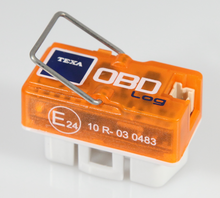
TEXA OBD log. Small information logger with the possibility to read out the information subsequently on PC via USB.
Data loggers are designed to capture vehicle data while the vehicle is in normal functioning, for later on analysis.
Information logging uses include:
- Engine and vehicle monitoring nether normal performance, for the purposes of diagnosis or tuning.
- Some US auto insurance companies offer reduced premiums if OBD-II vehicle data loggers[32] [33] or cameras[34] are installed - and if the driver'due south behaviour meets requirements. This is a course of automobile insurance risk selection
- Monitoring of driver behaviour by fleet vehicle operators.
Assay of vehicle black box information may be performed on a periodic footing, automatically transmitted wirelessly to a third party or retrieved for forensic assay after an event such as an accident, traffic infringement or mechanical mistake.
Emission testing [edit]
In the United States, many states now apply OBD-II testing instead of tailpipe testing in OBD-II compliant vehicles (1996 and newer). Since OBD-Two stores trouble codes for emissions equipment, the testing calculator can query the vehicle's onboard computer and verify there are no emission related problem codes and that the vehicle is in compliance with emission standards for the model year it was manufactured.
In the Netherlands, 2006 and later vehicles get a yearly EOBD emission check.[35]
Driver's supplementary vehicle instrumentation [edit]
Driver'due south supplementary vehicle instrumentation is instrumentation installed in a vehicle in addition to that provided by the vehicle manufacturer and intended for brandish to the driver during normal operation. This is opposed to scanners used primarily for active fault diagnosis, tuning, or hidden data logging.
Automobile enthusiasts have traditionally installed boosted gauges such as manifold vacuum, battery current etc. The OBD standard interface has enabled a new generation of enthusiast instrumentation accessing the total range of vehicle data used for diagnostics, and derived information such as instantaneous fuel economy.
Instrumentation may take the course of dedicated trip computers,[36] carputer or interfaces to PDAs,[37] smartphones, or a Garmin navigation unit.
As a carputer is essentially a PC, the same software could be loaded as for PC-based scan tools and vice versa, so the distinction is only in the reason for use of the software.
These enthusiast systems may too include some functionality similar to the other scan tools.
Vehicle telematics [edit]
OBD Ii information is commonly used by vehicle telematics devices that perform fleet tracking, monitor fuel efficiency, prevent unsafe driving, as well as for remote diagnostics and by Pay-As-You-Drive insurance.
Although originally not intended for the above purposes, commonly supported OBD 2 data such as vehicle speed, RPM, and fuel level allow GPS-based armada tracking devices to monitor vehicle idling times, speeding, and over-revving. By monitoring OBD II DTCs a company can know immediately if one of its vehicles has an engine problem and by interpreting the code the nature of the trouble. It can be used to detect reckless driving in existent fourth dimension based on the sensor information provided through the OBD port.[38] This detection is done by adding a complex events processor (CEP) to the backend and on the client's interface. OBD II is also monitored to cake mobile phones when driving and to record trip information for insurance purposes.[39]
OBD-II diagnostic trouble codes[40] [edit]
OBD-Ii diagnostic trouble codes (DTCs) contain one letter and 4 numbers, and are divided into the post-obit categories:
- B – Body (includes air conditioning and airbag) (1164 codes)
- C – Chassis (includes ABS) (486 codes)
- P – Powertrain (engine and transmission) (1688 codes)
- U – Network (wiring double-decker) (299 codes)
Standards documents [edit]
SAE standards documents on OBD-2 [edit]
- J1962 – Defines the physical connector used for the OBD-II interface.
- J1850 – Defines a serial data protocol. There are ii variants: 10.four kbit/s (unmarried wire, VPW) and 41.vi kbit/due south (ii wire, PWM). Mainly used by United states manufacturers, likewise known equally PCI (Chrysler, x.4K), Class 2 (GM, x.4K), and SCP (Ford, 41.6K)
- J1978 – Defines minimal operating standards for OBD-II scan tools
- J1979 – Defines standards for diagnostic test modes
- J2012 – Defines standards trouble codes and definitions.
- J2178-one – Defines standards for network message header formats and physical address assignments
- J2178-2 – Gives data parameter definitions
- J2178-3 – Defines standards for network message frame IDs for single byte headers
- J2178-iv – Defines standards for network messages with 3 byte headers*
- J2284-three – Defines 500K Tin can concrete and data link layer
- J2411 – Describes the GMLAN (Unmarried-Wire Can) protocol, used in newer GM vehicles. Ofttimes accessible on the OBD connector equally PIN 1 on newer GM vehicles.
SAE standards documents on Hard disk drive (Heavy Duty) OBD [edit]
- J1939 – Defines a information protocol for heavy duty commercial vehicles
ISO standards [edit]
- ISO 9141: Road vehicles – Diagnostic systems. International Organization for Standardization, 1989.
- Office ane: Requirements for interchange of digital information
- Function two: CARB requirements for interchange of digital information
- Office three: Verification of the communication between vehicle and OBD Ii scan tool
- ISO 11898: Road vehicles – Controller expanse network (Can). International Organisation for Standardization, 2003.
- Part 1: Information link layer and physical signalling
- Role 2: High-speed medium access unit
- Function 3: Low-speed, fault-tolerant, medium-dependent interface
- Function 4: Time-triggered advice
- ISO 14230: Road vehicles – Diagnostic systems – Keyword Protocol 2000, International Organization for Standardization, 1999.
- Role 1: Concrete layer
- Part 2: Data link layer
- Part 3: Awarding layer
- Role 4: Requirements for emission-related systems
- ISO 15031: Communication between vehicle and external equipment for emissions-related diagnostics, International Organisation for Standardization, 2010.
- Part 1: General information and utilise case definition
- Part 2: Guidance on terms, definitions, abbreviations and acronyms
- Part 3: Diagnostic connector and related electric circuits, specification and use
- Office 4: External test equipment
- Part 5: Emissions-related diagnostic services
- Office 6: Diagnostic problem code definitions
- Part 7: Data link security
- ISO 15765: Route vehicles – Diagnostics on Controller Surface area Networks (CAN). International Organization for Standardization, 2004.
- Role 1: General information
- Part 2: Network layer services ISO 15765-ii
- Part three: Implementation of unified diagnostic services (UDS on CAN)
- Part 4: Requirements for emissions-related systems
Security problems [edit]
Researchers at the University of Washington and University of California examined the security around OBD, and constitute that they were able to gain command over many vehicle components via the interface. Furthermore, they were able to upload new firmware into the engine control units. Their conclusion is that vehicle embedded systems are not designed with security in listen.[41] [42] [43]
At that place have been reports of thieves using specialist OBD reprogramming devices to enable them to steal cars without the use of a key.[44] The primary causes of this vulnerability lie in the tendency for vehicle manufacturers to extend the coach for purposes other than those for which it was designed, and the lack of authentication and authorization in the OBD specifications, which instead rely largely on security through obscurity.[45]
Encounter too [edit]
 | Wikimedia Commons has media related to Obd2. |
- OBD-Ii PIDs ("Parameter IDs")
- Unified Diagnostic Services
- Engine control unit of measurement
- Immobiliser
References [edit]
- ^ Digital Electronic Fuel Injection 16007.02-i. GM Product Service Training. August 1979.
- ^ "STE/ICE Design Guide for Vehicle Diagnostic Connector Assemblies" (PDF). United states of america: Department of the Army. August one, 1982. Retrieved May sixteen, 2020.
- ^ "On-Board Diagnostic 2 (OBD Ii) Systems Fact Sheet". US: California Air Resources Board. September 19, 2019. Retrieved March 12, 2020.
- ^ "Relating to measures to exist taken against air pollution by emissions from motor vehicles and amending Council Directive 70/220/EEC". The European Parliament and of the Quango. Oct thirteen, 1998. Directive 98/69/EC. Retrieved May 17, 2020.
- ^ "OBDII Compatibility". The states: PLX. Retrieved December 25, 2019.
- ^ "ISO 15765-4:2005 — Route vehicles — Diagnostics on Controller Area Networks (Tin can) — Part 4: Requirements for emissions-related systems". International Organization for Standardization. Jan 2005.
- ^ "Tin can Passenger vehicle Explained - A Unproblematic Intro (2021)". CSS Electronics . Retrieved November 22, 2021.
- ^ "GB 18352.6-2016 - PDF BOOK Auto-delivery". www.chinesestandard.net . Retrieved November 22, 2021.
- ^ "1320 ELECTRONICS LLC ALDL USER MANUAL Pdf Download | ManualsLib". world wide web.manualslib.com . Retrieved November 22, 2021.
- ^ "Reading GM'due south 160 baud ALDL Data Stream with a Standard PC Serial Port".
- ^ 1994 Corvette Service Manual, Volume two. General Motors Corporation. December 1993. pp. 6E3–A-166 : 6E3–A-223.
- ^ 1994 Corvette Service Manual, Book ii. General Motors Corporation. December 1993. pp. 6E3–A–11.
- ^ EEC Four Code Reader: For 2.9L 12 Valve & Early Tdi, Ford Scorpio
- ^ "OBD two Codes". AutoKnowIt.com . Retrieved Feb 27, 2022.
- ^ "Directive 98/69/EC of the European Parliament". Publications Function of the European Parliament.
- ^ "OBD-2 Check Engine Light Trouble Codes".
- ^ "Vehicle Standard (Australian Design Rule 79/01 – Emission Control for Light Vehicles) 2005". Australian Authorities ComLaw.
- ^ "Vehicle Standard (Australian Pattern Rule 79/02 – Emission Control for Light Vehicles) 2005". Australian Regime ComLaw.
- ^ "Diagnosing Series Data Buses". Baronial 25, 2016.
- ^ 14:00-17:00. "ISO 9141-2:1994". ISO . Retrieved February 19, 2020.
{{cite web}}: CS1 maint: numeric names: authors listing (link) - ^ Mahajan, Gauri; Parchandekar, S.1000.; Tahir, Mohammad (July 2017). "Implementation and Validation of K Line (ISO 9141) Protocol for Diagnostic Awarding" (PDF). International Research Journal of Engineering and Technology. 4 (seven). Retrieved August 15, 2020.
- ^ Miller, Tim (June 7, 2019). "How Can I Read OBD2 Freeze Frame Data?". OBD Planet . Retrieved July 22, 2020.
- ^ Miller, Tim (February 28, 2018). "How To Read OBD2 Freeze Frame Data". OBD Counselor . Retrieved November 23, 2021.
- ^ "Autoboss 30 Diagnostic Coverage Listing" (PDF).
- ^ "Intro to OBD-Ii vehicle diagnostics and GPS tracking". OBD By Tramigo.
- ^ "Driving Behaviour Identification based on OBD Speed and GPS Data Assay". Researchgate.
- ^ "OBD Software – Elm Electronics". Retrieved November 22, 2021.
- ^ "How to choose an OBD II adapter: Wi-Fi or Bluetooth - inCarDoc". CarDoctorPortal . Retrieved November 22, 2021.
- ^ Miller, Tim (Oct 31, 2021). "How Does OBD2 Software Work?". OBD Counselor.
{{cite web}}: CS1 maint: url-status (link) - ^ OBD Interpreter ICs
- ^ Miller, Tim (February 12, 2019). "OBD2 Diagnostic Software for Laptop/PC". OBD Advisor.
- ^ "OBD2 Data Logger - Easily Record & Visualize Your Car Data". CSS Electronics . Retrieved November 22, 2021.
- ^ "Home • IOSiX". IOSiX . Retrieved November 22, 2021.
- ^ "Advantages And Disadvantages Of A Dash Cam | Moneyshake Blog". Retrieved November 22, 2021.
- ^ "Periodic motor vehicle test (APK)". business.gov.nl . Retrieved Nov 22, 2021.
- ^ OBDuino open source OBD trip estimator
- ^ "Advantages and Disadvantages of Personal digital assistant". GeeksforGeeks. December 15, 2020. Retrieved November 22, 2021.
- ^ Shashika, Muramudalige (August 24, 2015). "Cloud-based driver monitoring and vehicle diagnostic with OBD2 telematics" (PDF). IEEE International Conference on Electro/Data Technology – via Academia.edu.
- ^ "What is Vehicle Telematics? Definition and FAQs | OmniSci". www.omnisci.com . Retrieved Nov 22, 2021.
- ^ Miller, Tim (October 25, 2021). "OBD2 Codes Guides and List for Free Download". OBD Advisor.
{{cite spider web}}: CS1 maint: url-condition (link) - ^ Bright, Peter (May 15, 2010). "Car hacks could turn commutes into a scene from Speed". Ars Technica . Retrieved Baronial 23, 2012.
- ^ Mastakar, Gaurav (Apr 6, 2012). "Experimental Security Analysis of a Modernistic Automobile". University of Washington and University of California San Diego. Archived from the original on September xx, 2012. Retrieved August 23, 2012.
- ^ Marks, Paul (July 17, 2013). "$25 gadget lets hackers seize control of a auto". New Scientist . Retrieved Nov five, 2013.
- ^ Riggers (July two, 2012). "Video: Fundamental play a joke on reprogrammers steal BMW in three mins". PistonHeads. Retrieved July 9, 2020.
- ^ Van den Brink, Rob (July 10, 2012). "Dude, Your Car is Pwnd" (PDF). SANS Establish. Archived from the original (PDF) on Feb 23, 2013.
- Notes
- Birnbaum, Ralph and Truglia, Jerry. Getting to Know OBD II. New York, 2000. ISBN 0-9706711-0-v.
- SAE International. On-Board Diagnostics for Low-cal and Medium Duty Vehicles Standards Manual. Pennsylvania, 2003. ISBN 0-7680-1145-0.
External links [edit]
- Directive 98/69/EC of the European Parliament and of the Quango of thirteen Oct 1998.
- National OBD Clearing House Middle for Automotive Scientific discipline and Engineering science at Weber Country University
- OBD-II Codes Definition OBD-II codes definition, description and repair information.
- OBD2 Codes Guides OBD2 trouble codes pregnant, fixes, lookup, and full list for free download
- United States Environmental Protection Agency OBD information for repair technicians, vehicle owners, and manufacturers
- OBD2 Vehicle Plug Pinouts including compatibility lists Manufacturer Specific OBD-2 diagnostics pinouts and compatibility information.
- Video of a BMW being stolen after thieves were able to access the vehicle'south OBD interface on YouTube
Source: https://en.wikipedia.org/wiki/On-board_diagnostics
0 Response to "Car Reader Plug on 2007 Ford Bad Environmental Read"
Post a Comment